Heritage & History · Feature
Riad or dar: the house that turns its back on the street
From the alley, you see nothing. A blank wall, a studded door, sometimes a knocker shaped like a hand. Then the door opens, a dog-leg passage steers you aside, and the house reveals itself all at once: a courtyard, sky, often water. But does that courtyard hold a garden? That is the whole difference between a riad and a dar.
A word, a garden
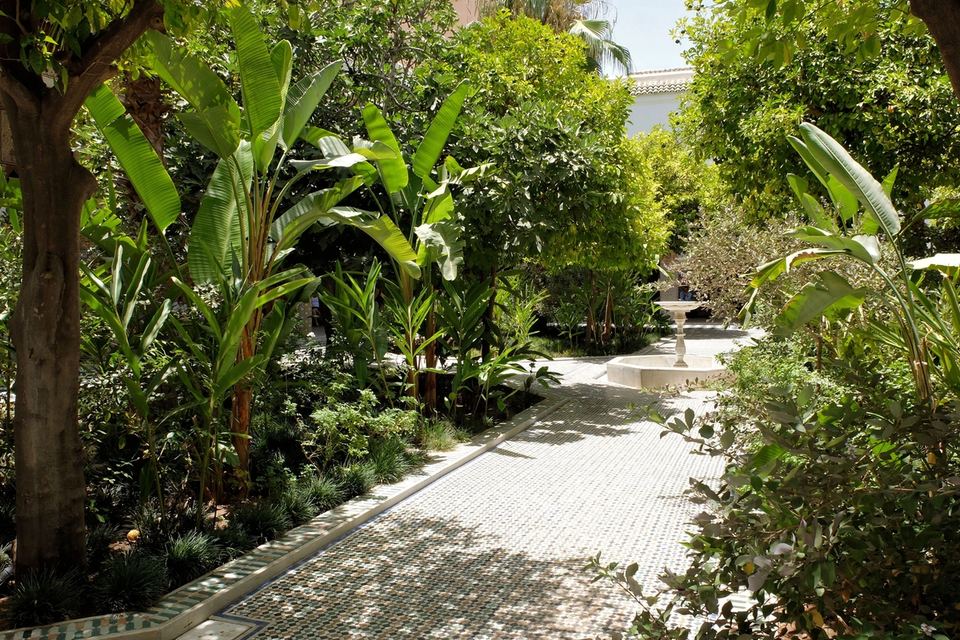
Riad comes from the Arabic ryād, plural of rawda, the garden. The Académie française’s dictionary records it in French in the twentieth century, and defines it more broadly as a traditional medina dwelling organised around a patio or an inner garden.
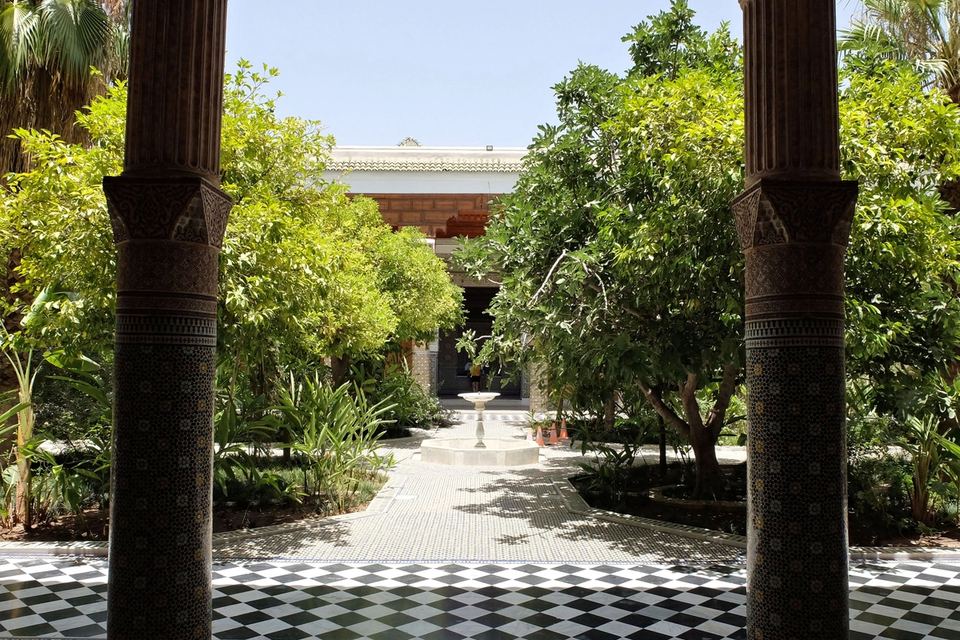
In the strict sense, that of etymology and of architectural historians, the riad is a house arranged around a planted inner garden. In its classic form, as described by architectural historians, two intersecting paths divide this garden into four beds, with a fountain at the centre.
The dar, a courtyard house
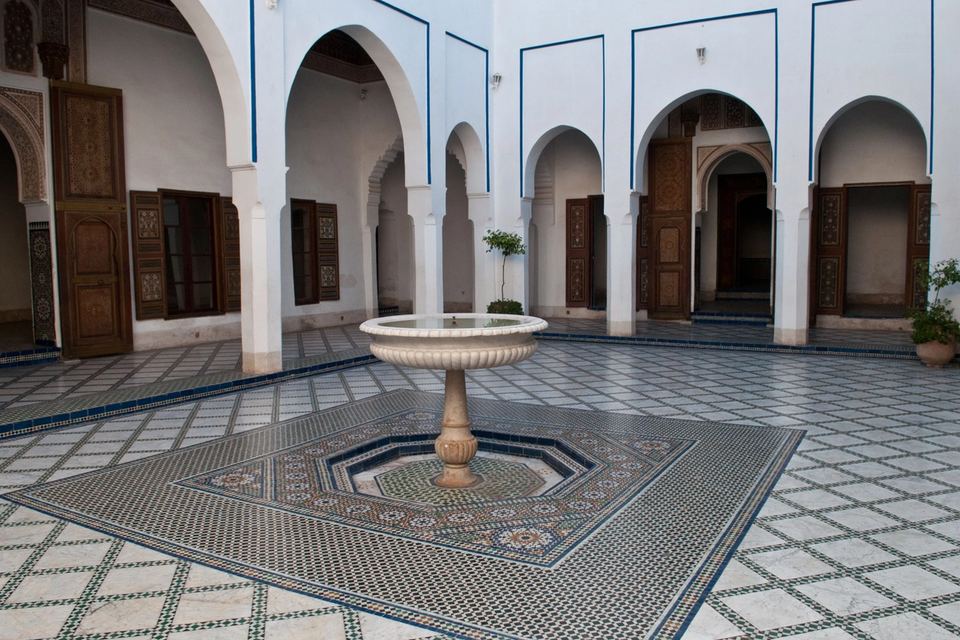
The dar, by contrast, is a town house built around an inner courtyard, with no planted garden. The courtyard is paved, sometimes graced with a fountain, and the rooms open onto it.
| Riad | Dar | |
|---|---|---|
| Heart of the house | Planted garden, often in four beds | Paved courtyard |
| Size | Often larger | Variable, often more modest |
| Common ground | Closed façade, life turned inward | Same |
A story of palaces
According to archaeological research, one of the oldest known four-part gardens in Morocco belonged to an Almoravid palace in Marrakech, uncovered beneath the Koutoubia and dated to the early twelfth century. How much it owes to an Andalusian inheritance, as opposed to local development, is still debated.
The model then flourished in the great residences. At the Saadian El Badi palace, the courtyard becomes an immense garden: a great central pool flanked by four sunken gardens. In the nineteenth century, the Bahia palace, built in two phases between 1859 and 1900, lines up courtyards and gardens across nearly eight hectares, according to Archnet. Dar Si Saïd, a late-nineteenth-century residence that became a museum as early as 1932, now houses the National Museum of Weaving and Carpets.
How ‘riad’ became a brand
From the late twentieth century, foreign buyers crowded into the alleys. A university study by Anton Escher and his colleagues found that, by the end of November 2000, 457 foreigners had bought more than 500 houses in the medina, and that at least 110 European-owned houses there were being run as guest houses.
The same study was already noting a shift: foreigners were calling any medina house a ‘riad’, garden or not. The word has become a marketing promise.
And where does the law stand?
For tourist accommodation, Law 80-14 and its implementing regulations make the riad a category of its own, distinct from the guest house, with its own standards and grading (see the steps to opening a guest house). The everyday word and the legal category, then, do not always coincide.
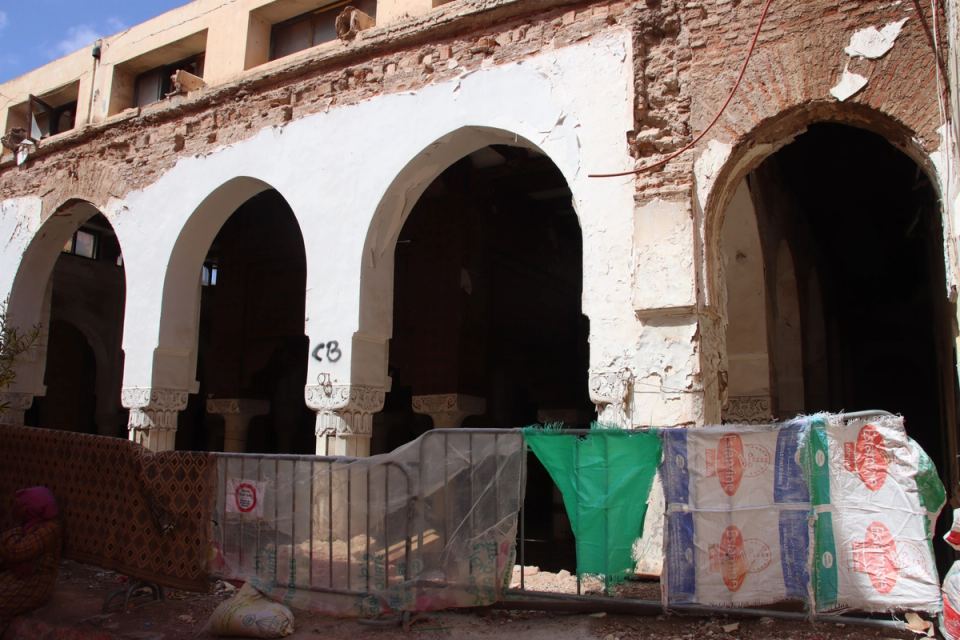
A well-restored dar is often better than a misunderstood riad. What counts is how much of its history the house has kept.
Sources
- Dictionnaire de l'Académie française, 9th edition, entry ‘riad’
- A. Escher, S. Petermann, B. Clos, ‘Le bradage de la médina de Marrakech ?’ (The sell-off of the Marrakech medina?), in M. Berriane and A. Kagermeier (eds), Le Maroc à la veille du troisième millénaire (Morocco on the eve of the third millennium), proceedings of the 6th Moroccan-German colloquium in Paderborn, Rabat, FLSH, 2001, pp. 217-232 (quoted from pp. 219, 222, 228)
- Archnet, entry on the Bahia palace
- Le Matin (29/06/2018) on Dar Si Saïd
- Law 80-14 and Decree 2-23-441
- Q. Wilbaux, La médina de Marrakech (L'Harmattan); G. Marçais, L'architecture musulmane d'Occident (Paris, Arts et métiers graphiques, 1954): works cited from the English Wikipedia article ‘Riad (architecture)’, not consulted directly and without verified page numbers
- A. Stockstill, ‘Kutubiyya Courtyard’, Middle East Garden Traditions (Dumbarton Oaks), via Archnet
- Archnet, entry on the El Badi palace
The Newsletter
The essentials on Marrakech riads, every week.
Market, heritage, renovation and law: a selection by our editors.